A practical way to evaluate stainless bushcraft knife listings: what a stainless blade claim does and does not tell you, which stated facts to compare, and how the supplied Outdoor Survival knife Straight Knife High Hardness EDC Knife fits as one catalog example.
Why "stainless" narrows the field but does not pick a winner
Searching for the best stainless bushcraft knife usually means you want a blade that tolerates damp conditions and needs less fuss than a high-carbon alternative. That is a reasonable starting point, but stainless is a broad family rather than a single grade. General knife education explains that modern steels use different alloy compositions to obtain different balances of properties, including corrosion resistance, toughness and wear resistance. That principle explains why two knives both described as stainless can behave differently, but it does not establish the properties of any particular knife.
So the honest answer is that no listing, and no single catalog example, can name the best stainless bushcraft knife for you. What a listing can do is tell you the stated blade material, dimensions, thickness, hardness and handle material of a specific item. Those facts let you compare candidates on paper. They do not prove how a knife carves, how an edge holds up over a season, or how it feels in your hand after an hour of work, and no independent test results are supplied here to fill that gap.
What the supplied stainless example actually states
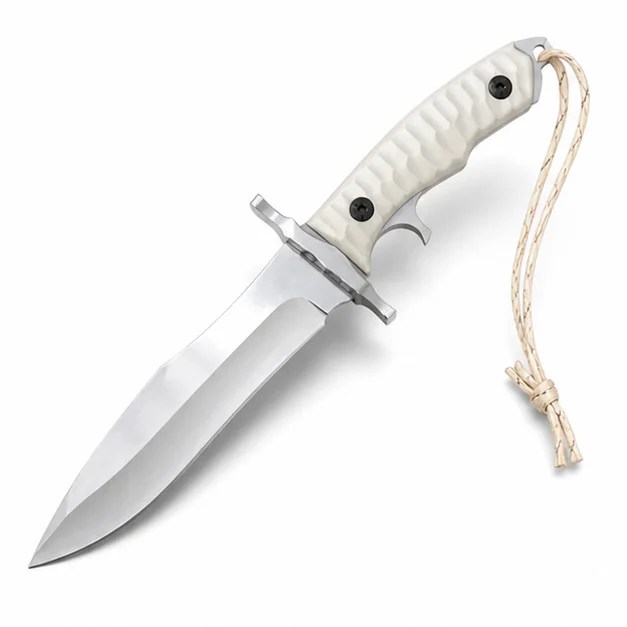
The Outdoor Survival knife Straight Knife High Hardness EDC Knife is one stainless-format fixed knife in the catalog, and it is useful as a worked example of how to read a listing rather than as a recommendation. Its description names a high-quality stainless steel blade and a G10 composite handle. The stated figures are a blade thickness of approximately 4 mm, a hardness of HRC 58, an overall length of approximately 20 cm and a blade length of approximately 9 cm.
Read those numbers as the listing's stated facts, not as measurements anyone has checked. The 4 mm thickness and 9 cm blade length describe a mid-sized fixed knife by the figures given, and the HRC 58 line is the listing's stated hardness rather than a measured result. The description also uses general wording about edge retention and corrosion resistance. Treat that as the listing's own phrasing about the material, not as a tested performance claim, and note that the listing does not name a specific steel grade. If a grade matters to your decision, that is a question for the seller.
The listing also does not describe a care or sharpening routine, or say whether the blade or any part of the knife is user-replaceable or serviceable. Those are open questions rather than things to assume in either direction.
Criteria worth comparing across stainless candidates
Compare like with like. Put the stated blade length, overall length, blade thickness and weight of each candidate side by side, and check that each figure describes the same thing. A blade length measured from the handle junction to the tip is not the same as a sharpened-edge length, and a listing that does not say which convention it uses leaves the figure open. Where a weight is given, check whether it covers the knife alone or the knife with its sheath, since those figures are not directly comparable.
Look at what each listing names for the blade material and the handle material, and note where a listing is silent rather than filling the gap yourself. A named stainless grade is a starting point for questions about care and sharpening, not proof of how a particular knife will behave. Where hardness is stated, read it as the listing's figure. Carry and storage deserve the same scrutiny: a bushcraft knife is usually worn or packed with a sheath, so check what the listing says about the sheath and its attachment, and ask if it says nothing.
If a particular figure decides your choice, ask the seller to confirm that figure and how it was taken. A reply that restates the number has not resolved anything; a reply that names the measurement points and the package contents has. Check the rules that apply where you intend to carry any knife before you do so.
Does the Outdoor Survival knife Straight Knife High Hardness EDC Knife name a specific stainless steel grade?
No. The description says high-quality stainless steel but does not name a grade. The stated hardness is HRC 58. Ask the seller for the specific grade if that matters to your choice.
Can a listing tell me which stainless bushcraft knife is best?
No. A listing can give stated size, thickness, hardness and materials for comparison, but it cannot establish how a knife carves, how an edge holds up, or how it feels in use. No independent test results are supplied here.