A practical method for comparing stainless steel knives from their listings: what the category name covers, which stated facts to line up, and how to handle missing or conflicting figures.
Start with what each listing actually names
Two knives can both be sold as stainless steel and still tell you very different amounts about themselves. Stainless steel is a material family, not a grade, so the label alone does not rank one blade above another. General knife education explains that modern steels use different alloy compositions to reach different balances of properties such as toughness, wear resistance and corrosion resistance. That principle explains why the category name cannot settle a comparison, but it does not establish the properties of any particular knife.
The first useful step is therefore to note how specific each listing is. Does it name a steel grade, or only say stainless steel? Does it give a hardness figure? Does it state dimensions and a handle material? A page that names a grade and a hardness value gives you more to work with than one that says only high-quality stainless steel, even though neither proves how a finished edge will behave in your hands. Treat a grade name as an intended material family, not as evidence of heat treatment, edge geometry or real-world performance.
Line up the stated facts side by side
Build a small table from what each listing states and leave the empty cells empty. Worth capturing: the exact blade material wording, any stated hardness, blade length, blade thickness, overall length, handle material and weight. Those figures describe size and mass class and let you compare models on paper. They say nothing about edge retention, and a photograph cannot settle steel, hardness or treatment either.
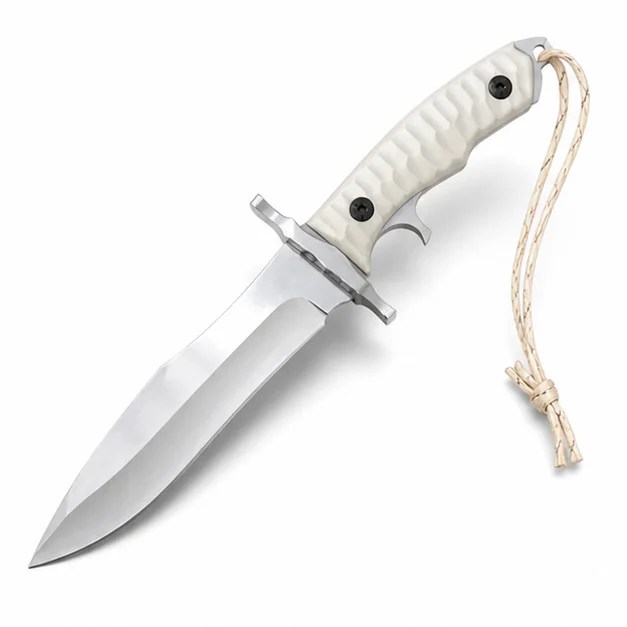
A catalog example of the thinner end of this information is the Outdoor Survival Knife Straight Knife High Hardness EDC Knife. Its listing states a high-quality stainless steel blade, a G10 handle, a blade thickness of approximately 4 mm, a hardness of HRC 58, an overall length of approximately 20 cm and a blade length of approximately 9 cm. Those are the listing's stated figures, not measurements anyone has checked. Note what the same listing does not give: a named steel grade, a care routine or a sharpening method. Use it as one example of how a stainless claim can sit alongside a hardness figure but still leave the grade open, not as a tested winner over any other knife.
Where a listing gives both a category and a hardness number, read them as two separate statements. The hardness figure is a stated value for that model; it does not tell you which stainless grade produced it, and it does not transfer to a different knife that uses similar wording.
Check measurement conventions before comparing numbers
Two listings can quote blade length and still not be comparable, because the figure needs a start and an end point. A blade length may run from the handle junction to the tip or cover only the sharpened edge, and listings often do not say which. Blade thickness has the same gap: a single figure may be taken at the spine, at the thickest point, or near a tapered tip. Before you set one blade length against another, ask each seller how the figure was taken.
Unit consistency is the other easy check. Ordinary conversion is safe where the listing is internally consistent, so 4 mm equals 0.4 cm and 9 cm equals 90 mm. That arithmetic changes how a figure is written, not what it measures. If a listing gives the same dimension in both metric and imperial and the two do not agree, do not pick the one you prefer; treat the figure as unresolved and ask.
What the comparison cannot tell you
No amount of listing reading establishes corrosion resistance, sharpening difficulty, edge retention in your use, or how a handle feels. Those are not implied by the words stainless steel, by a hardness figure, or by a material name attached to the handle. A stainless label identifies a material category; it does not promise freedom from corrosion or remove the need to consider moisture, salt, cleaning and storage.
Where a listing is silent on care, sharpening, hardness or whether any part of the knife is serviceable, the accurate position is that those facts are missing. Ask the seller for the specific grade, the care guidance for that exact model, and whether the blade or any part of the knife is user-replaceable. A reply that names the grade and the care method resolves the question; a reply that repeats the marketing wording does not.
The practical conclusion is modest: compare stainless blades by how specifically each listing documents its steel, its stated hardness and its dimensions, then confirm the measurement conventions and care guidance with the seller. Keep the blade clean and dry after ordinary use, follow any maker instructions supplied with the knife, and check local carry rules before carrying.
Is one stainless steel blade better than another just because it states a higher hardness?
Not on the listing alone. A stated hardness figure is one data point for that model, and the listing usually does not name the steel grade, the heat treatment or the edge geometry behind it. General education explains that alloy composition affects properties such as toughness and corrosion resistance, but that does not establish how a particular finished blade performs. Compare the full set of stated facts and ask the seller what is missing.
Does the Outdoor Survival Knife Straight Knife High Hardness EDC Knife name its blade steel grade?
No. The listing describes a high-quality stainless steel blade and states a hardness of HRC 58, but it does not name a specific grade, a care routine or a sharpening method. Ask the seller for the grade if that matters to your choice.