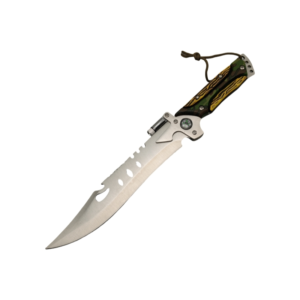
A comparison of the stated blade length, blade thickness, cutting material, handle material, sheath wording and one-piece keel wording on the supplied boning knife and fixed-blade listings, limited to what each listing documents.
The two listings do not give you the same set of facts
The Small, Straight Bone-cutting One-piece Keel Boning Knife and the (B26) 's Tactical Straight Fixed Blade Knife are presented for different jobs, and the supplied facts do not let you compare them on equal terms. The boning knife listing gives a total length of 31.3 cm, a blade length of 18.2 cm, a blade width of 3.7 cm, a blade thickness of 3 mm, a cutting material of 5CR, a stem material of red sandalwood and a net weight of 192 g. The (B26) listing gives a total length of 29.7 cm, a blade length of 15.5 cm, a blade width of 3.6 cm, a blade thickness of 3.9 mm, a 440C blade material, a colored wood handle with a stated handle length of 12.5 cm, handle width of 3.0 cm and handle thickness of 20.0 mm, and a net weight of 316 g.
The arithmetic is straightforward. The boning knife's stated blade length is 2.7 cm longer than the (B26)'s, and its stated total length is 1.6 cm longer. Its stated blade thickness is 0.9 mm thinner. Its stated net weight is 124 g lighter. Those are comparisons of stated figures, not statements about how either knife cuts, balances or feels.
The third supplied listing, the Multi-Function Survival Knife Wood Handle and Lanyard Design Outdoor Tactical Knife, gives a 420 stainless steel blade and a wood handle, with a lanyard named in the title. It states no length, thickness or weight, so it cannot be placed on the same numerical footing as the other two.
What the blade wording lets you compare
The boning knife's name describes it as small, straight, bone-cutting, one-piece and keel-shaped. Read those as the listing's own descriptive words for the blade form, not as tested results. Its cutting material line reads 5CR, which is a steel-family label rather than a measured property, and the listing gives no hardness figure.
The (B26) listing names 440C as its blade material and gives no hardness figure either. Neither listing says where along the blade its thickness figure was taken, whether it is a maximum at the spine or a single reading, so the 3 mm and 3.9 mm figures should not be treated as like-for-like readings at the same point.
Neither listing describes a sharpening method, an edge angle or a care routine. If you want guidance on maintaining either edge, that is a question for the seller rather than something the listings settle.
Handle wording, sheath wording and the one-piece note
The boning knife listing does not use a handle line. It states Stem material: Red sandalwood, and it does not explain which part of the knife the word stem covers. The (B26) listing states Handle material: colored wood, a general name for wood that has been given a colour rather than a species name. Neither listing describes a surface texture, a finish or a care routine for the handle material.
On the sheath question, neither the boning knife nor the (B26) listing names a sheath at all. Where a sheath line is absent, that fact is simply undocumented, so ask the seller whether one is included and what it is made of before you rely on it.
The boning knife's product name says one-piece, and the listing separately names a stem material. The listing does not explain how those two statements relate, and it does not describe how the knife is assembled. Neither listing states whether the blade or any other part is user-replaceable or serviceable. Where that is missing, it is missing; do not assume either a permanent or a replaceable arrangement.
How to use these facts in a home game-processing decision
If a stated blade length and a stated lighter net weight are what you want documented, the boning knife gives you 18.2 cm and 192 g. If a stated blade thickness and a stated handle length are what you want documented, the (B26) gives you 3.9 mm and 12.5 cm. Those are the clearest documented differences between the two.
If a named sheath is part of what you need confirmed, neither listing supplies it, so that belongs in your message to the seller. The same applies to hardness, sharpening guidance and whether any part is serviceable.
Neither listing states how either knife performs on game, how a handle feels in hand, or how the two compare in cutting. Those are not documented, and the honest position is to compare the stated figures against your own needs and to ask the seller about the missing details that matter to you.
Do both listings state a blade thickness?
Yes. The boning knife states 3 mm and the (B26) states 3.9 mm. Neither listing says where along the blade the figure was taken or whether it is a maximum, so the two numbers are not confirmed as like-for-like readings.
Does either listing name a sheath?
No. Neither the boning knife nor the (B26) listing gives a sheath line, so sheath inclusion and material are undocumented and should be confirmed with the seller.
Does the boning knife listing explain what the stem is?
No. It states Stem material: Red sandalwood but does not explain which part of the knife the word stem covers, and it does not say how that relates to the one-piece wording in the product name.