A plain reading of the phrase "full G10 knife": what G10 is as a material name, why "full" is ambiguous in knife listings, and how to check which parts of a knife a G10 claim covers.
G10 is a handle material, not a whole-knife description
G10 is a composite laminate made from woven glass fibre cloth bonded with resin under heat and pressure. In knife listings it is almost always named as a handle or scale material, because that is the part of a knife where a laminate's properties are usually wanted.
That means a search for a "full G10 knife" is really a search for a knife whose handle is G10. The word "full" is where the confusion starts, because it is not a standardised knife term the way "full tang" is. It can mean the handle is G10 along its whole length, that the scales are solid G10 rather than a thin G10 overlay on another material, or simply that the seller wants to emphasise the handle material. A listing that says "full G10" without explaining it has not told you which of those it means.
Check which components the G10 claim covers
The useful question is not whether a knife is "full G10" but which parts are documented as G10. A handle can be G10 while the liners, pins, bolsters or backspacer are steel or another material, and none of that is a contradiction. It is simply a different construction.
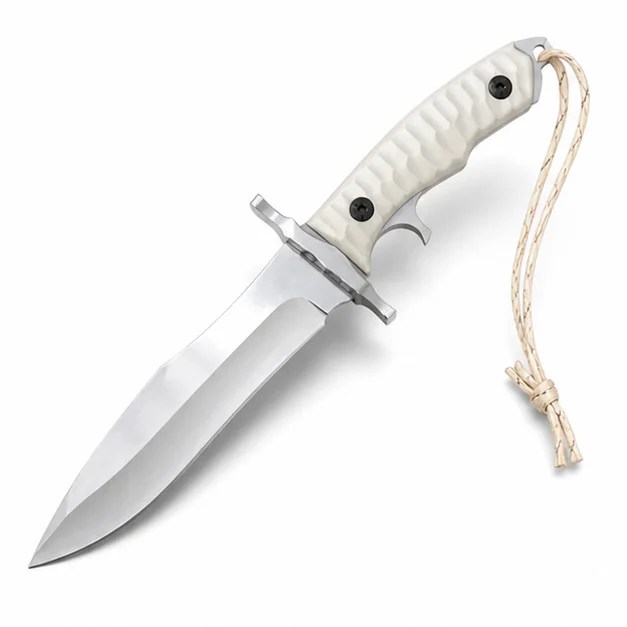
A catalog example shows how this reads in practice. The Outdoor Survival knife Straight Knife High Hardness EDC Knife states a handle material of durable G10 composite, alongside a stainless steel blade, a stated blade thickness of approximately 4 mm, a stated hardness of HRC 58, an overall length of approximately 20 cm and a blade length of approximately 9 cm. The G10 claim is attached to the handle only. The listing does not describe the liners, fasteners or any other component, and it does not use the phrase "full G10" at all.
Read that as one example of how a G10 handle is documented, not as a recommendation. Where a listing is silent on the other components, the honest position is that those facts are missing rather than that they are G10 or not G10.
What the phrase does not tell you
G10 as a material name says nothing on its own about how a handle will feel in hand, how much grip it provides, or how it will wear. Those are properties of a specific handle's shape, surface texture and finish, and a material label does not establish them. The same applies to corrosion resistance, weight and durability.
If the handle construction matters to your decision, ask the seller a question that produces a specific answer: which parts of this knife are G10, is the G10 a solid scale or a layer over another material, and what are the liners and fasteners made from? A reply that names the parts resolves the point. A reply that only repeats "full G10" does not.
The supplied facts for the example above also do not state a care or sharpening routine, or whether the blade or any part of the knife is replaceable or serviceable. Those are open questions for the seller rather than things to infer from the handle material.
Does "full G10" mean the whole knife is G10?
No. G10 is a handle and scale material. A blade is steel, and liners, pins and other fittings are usually metal. The phrase is not a standard term, so ask the seller which parts are actually G10.
Is "full G10" the same as "full tang"?
No. Full tang describes how the blade steel extends through the handle. G10 describes a handle material. The two terms answer different questions and a knife can have either, both or neither.
What handle material does the example knife state?
The Outdoor Survival knife Straight Knife High Hardness EDC Knife states a handle of durable G10 composite. The listing does not describe the liners or fasteners, and it does not use the phrase "full G10".