














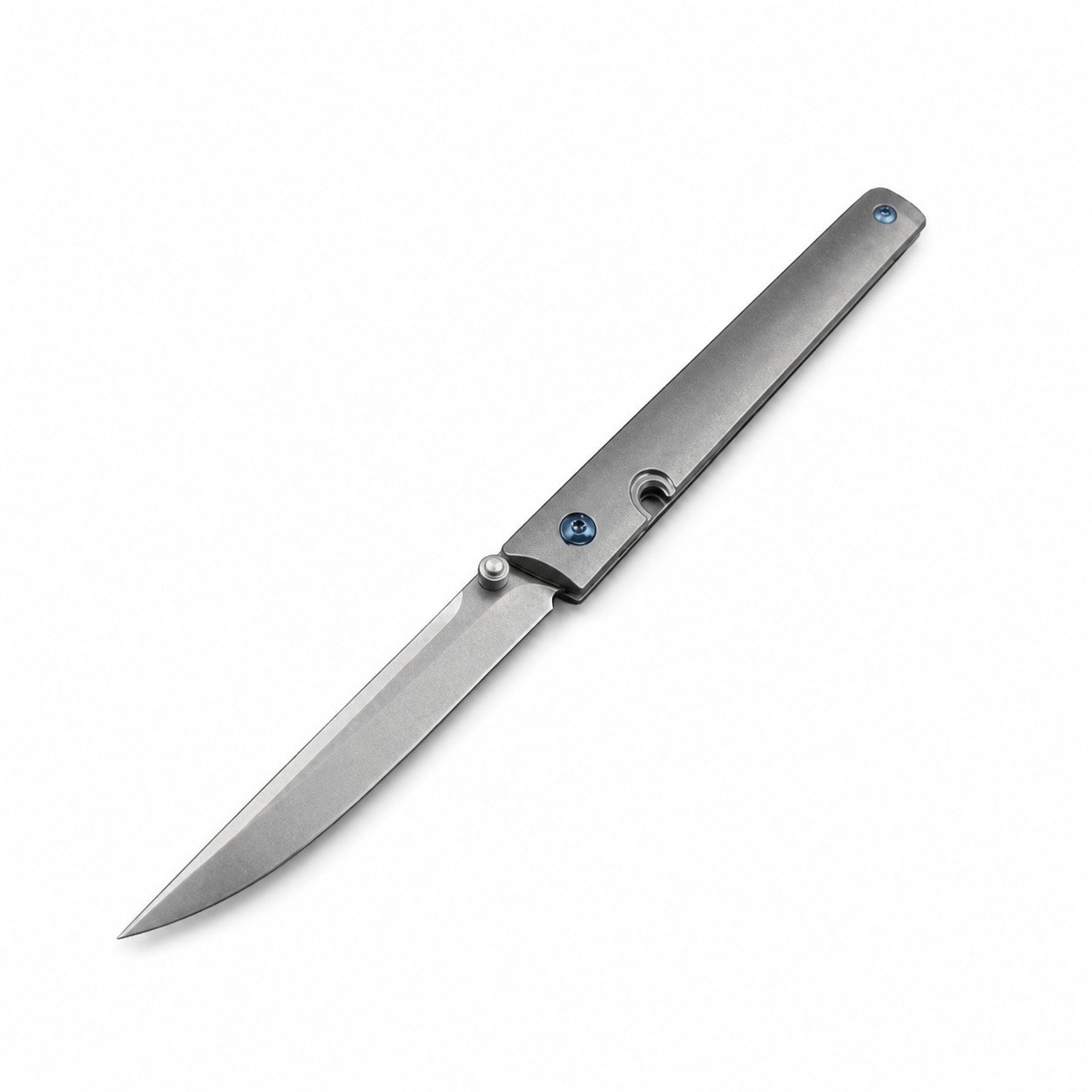
Understand what a frame lock knife is, how to check its engagement, and what to verify before choosing a folding outdoor knife.
What is a frame lock knife?
A frame lock knife uses part of the handle frame to hold the blade open. As the blade reaches its open position, the frame section is intended to move against the blade’s tang and help prevent unintended closing. The term knife frame lock describes a mechanism category, not a guarantee about every knife’s materials, fit, or performance.
What to check before choosing one
Confirm that the product listing explicitly states a frame lock. Examine the handle shape, closed size, blade dimensions, and carry arrangement, then consider whether they suit your ordinary cutting tasks. A photograph alone cannot reliably identify the lock mechanism or confirm how it operates.
The supplied 7096 listing identifies a folding knife with a D2 blade, titanium-alloy handle, 8.0 cm blade length, and 60 g net weight. It does not state that the knife has a frame lock. Those facts should not be expanded into an unsupported mechanism claim.
Using and maintaining the mechanism
Open the knife carefully and keep fingers away from the blade path. Before cutting, check visually that the locking area is engaged as described in the instructions. Do not deliberately stress, strike, or modify the lock. Keep dirt and moisture from accumulating, and stop using the knife if the blade feels loose or the lock behaves unexpectedly.
Close the knife with the same care and store it closed where appropriate. Follow local carry rules and keep it away from children.
Is every folding knife a frame lock knife?
No. Folding knives use different locking and non-locking designs, and a product name or photograph may not identify the mechanism reliably. Confirm the lock type in the current specifications or instructions. If it is not stated, treat it as unknown rather than assuming it is a frame lock.
How can I check a frame lock before cutting?
Open the knife according to its instructions, keep hands clear of the edge, and visually confirm that the frame section is positioned as intended. Do not force or test it aggressively. If the blade shifts, the lock does not engage, or anything feels abnormal, stop using the knife.