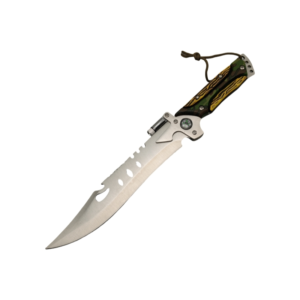
A plain reading of the lanyard design wording on the Multi-Function Survival Knife Wood Handle and Lanyard Design Outdoor Tactical Knife listing: what the term names about the knife, and what the listing leaves unstated.
What the lanyard wording actually says
On the Multi-Function Survival Knife Wood Handle and Lanyard Design Outdoor Tactical Knife listing, the lanyard appears in two places. The product name carries the phrase lanyard design, and the short description has a line reading Lanyard Design: Convenient for carrying and securing the knife during outdoor activities. The main description adds that the integrated lanyard ensures you can easily carry it wherever your adventure takes you.
Read those as one kind of statement: the listing names a lanyard as a feature of the knife and attaches its own carrying language to it. The word design is a label for the feature, not a specification. It tells you the listing presents the knife as having a lanyard, and it distinguishes this listing from one that names no lanyard at all. That is the whole of what the note establishes.
What the term describes about the knife
A lanyard, in ordinary knife naming, is a cord or loop attached to the knife so that it can be tied off or held separately from the blade end. The listing uses the term in that ordinary sense and calls the lanyard integrated, which presents it as part of the knife rather than a loose accessory.
What the listing does not do is describe the lanyard itself. It does not state the cord material, the cord diameter, the length, the colour, or how the lanyard is fixed to the knife. It does not say whether the lanyard passes through a hole in the handle, attaches at a pommel, or is formed some other way. Nor does it say whether the lanyard is removable or fixed. Those are separate questions, and the wording does not answer them.
The carrying and securing language in the short description is the listing's own phrasing about what the lanyard is for. It is not a statement about how much load the lanyard holds, how it behaves when wet, or how it should be used. Treat it as a purpose label rather than a performance claim.
Reading it alongside the rest of the listing
The lanyard lines sit among other stated facts: a 420 stainless steel blade, a wood handle, and a package line reading one product as shown in the selected option and product images. The listing gives no blade length, blade thickness, overall length, weight or hardness figure, so the lanyard note cannot be checked against dimensions.
The description also calls the handle ergonomic and the grip secure, and the short description calls the grip comfortable and non-slip. Those are the listing's descriptive words about the handle, not measured results, and they do not add detail to the lanyard wording. The lanyard note and the handle wording describe different parts of the knife.
The listing does not describe whether the lanyard, the handle, the blade or any other part of the knife is user-replaceable or serviceable. Where a fact is missing, the honest position is that it is missing.
What to ask the seller
If the lanyard matters to your decision, ask a question that produces a specific answer rather than a repeat of the product name. For example: what material and length is the lanyard, where and how is it attached to the knife, and is it removable? Ask for current photographs of the exact version being offered if the appearance of the lanyard matters.
A reply that names the material, the attachment point and whether the lanyard comes off resolves the point. A reply that only restates lanyard design does not. Treat the listing wording as the seller's stated feature, not as a verified description of the cord or its fixing.
Does the lanyard design note tell me how strong the lanyard is?
No. The listing names a lanyard as a feature and describes it as convenient for carrying and securing the knife, but it gives no cord material, diameter, attachment detail or load information. Treat the wording as a feature label rather than a strength claim.
Does the listing say whether the lanyard can be removed or replaced?
No. The listing calls the lanyard integrated but does not describe how it is fixed or whether it is user-removable. Ask the seller if that matters to you.
Does the lanyard note say how the knife should be carried?
No. The listing says the lanyard is convenient for carrying and securing the knife during outdoor activities, but it does not describe a carry method, a sheath, or an attachment to anything else. That wording is the listing's own description of purpose, not a carry instruction.